

6 min read

In CPG, the shelf you plan against is the shopper's shortlist. Six brand-lift studies show what high-impact creative does to it, and what that should change about the plan.
If you plan CPG, the shelf you are planning against is the shopper's shortlist, & creative is what gets a brand onto it. Six CPG brand-lift studies run with Echelon Insights put the consideration lift from high-impact creative at 26 points, matching PadSquad's 131-study portfolio average & edging a 13-study retail read at 25 points.
That matters for how a plan is built. US CPG digital ad spend reaches $58.85B in 2026 & $65.94B in 2027, a 12.1% increase. Roughly $7B in new dollars will chase the same shortlists. Reach & frequency get optimized to the decimal while creative is treated as the constant in the equation.
The brand-lift data says creative is the variable that moves. Three planning decisions follow from it: which KPI leads the brief, how the format mix splits across the funnel, & how the measurement is designed so the result is readable when it lands.
The lift is real, & it sits in two places
Across six CPG brand-lift studies in 2025, high-impact creative drove a 26-point lift in consideration, a 9-point lift in strong favorability & a 7-point lift in purchase likelihood.

First, consideration carries the category. The 26-point lift matches the 131-study portfolio average & comes off half the sample size of the retail read.
Second, the lift concentrates in the top box. Strong favorability moved 9 points against 5 for overall favorability, about 1.8 times. In parity aisles, where products are near-identical & price is under pressure, that gap is the whole argument. Lukewarm approval does not protect price or win the re-buy.
Purchase likelihood at +7 trails the portfolio average of +9, so it is honest to say this data set is strongest upper & mid-funnel. The down-funnel proof comes from campaign & sales studies.
Consideration is zero-sum, & creative moves both sides of it
A 2026 Echelon study for a hydration brand (n=604) is the clearest read we have on what high-impact creative does to a category. Exposed shoppers lifted consideration for the advertised brand by 35 to 42 points. Over the same study, consideration for two leading competitors fell 15 to 16 points.
That is the part worth planning around. A brand did not simply get added to a list; it took a spot from someone else. First-choice ranking moved 19 to 21 points & awareness moved 49 to 54 points in the same study.
Named proof holds the same shape. Ben & Jerry's interactive video drove a 35-point consideration lift against competitors & a 148% higher CTR than the industry benchmark, alongside a 39% increase in likelihood to try new flavors.
The planning consequence is in the study design. Consideration is a share metric, so a brand-lift design that tracks only your brand will miss the displacement, which is the strongest part of the story. Write competitor consideration & first-choice ranking into the survey before the campaign goes live. Retro-fitting them is not possible.
Format is a KPI decision
The format-level reads split cleanly by what they move, which makes them an allocation tool. Weight video & CTV where the objective is category entry & shortlist position, then hold budget for interactive units that carry intent down-funnel.
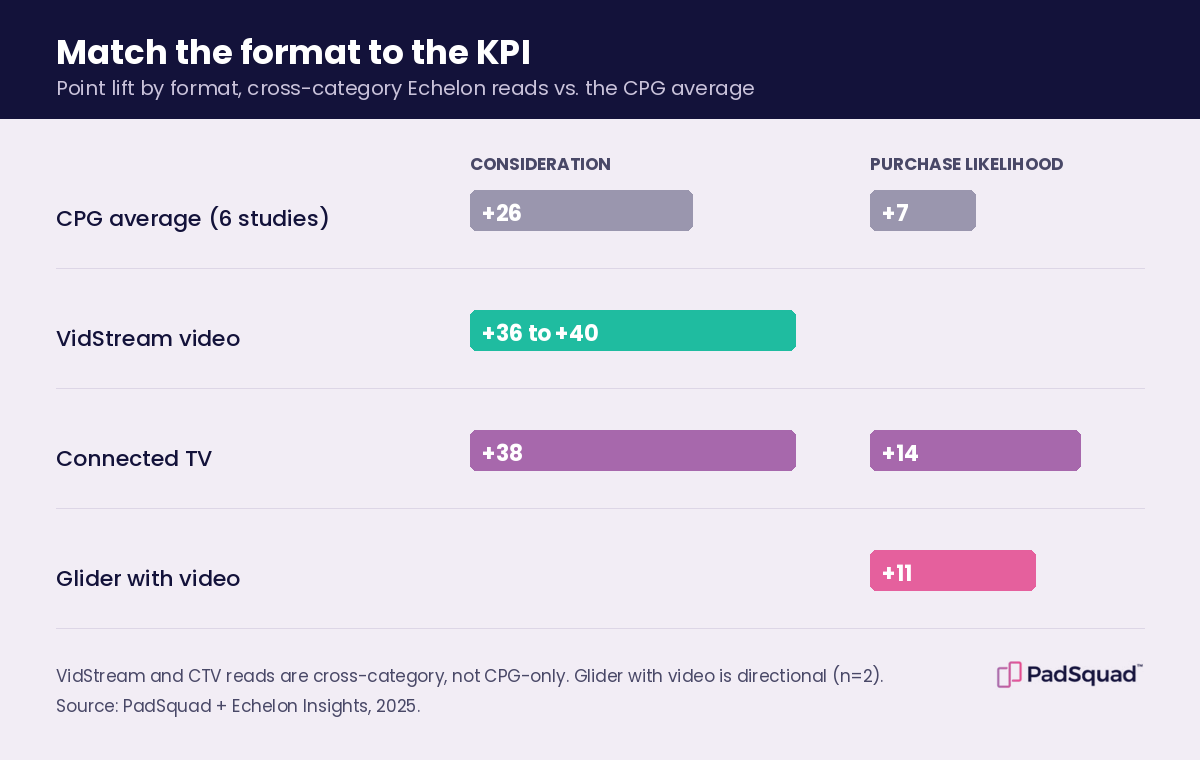
Video is the lead consideration lever, lifting consideration 36 to 40 points, roughly 1.4 to 1.5 times the portfolio average. Connected TV carries both ends, posting 38 points of consideration alongside the strongest purchase-likelihood lift in the data at 14 points. Interactive video is what moves people toward buying: Glider with video lifted purchase likelihood 11 points, & Tile with video lifted very favorable opinion 13 points. Both interactive reads are directional, drawn from small samples & cross-category rather than CPG-only.
The in-market engagement numbers point the same way. A Purina Fancy Feast launch hit a 33% engagement rate & 11,000 hours of engagement while reaching 17M+ cat owners. An Aidells slide-to-reveal unit drove engagement nearly six times benchmark. For a new SKU, participation is the product demo the digital shelf cannot otherwise give, & trial intent is the scorecard: Stella & Chewy's AR campaign lifted purchase intent 21 points, consideration 17 & aided awareness 18.
Earn the intent, then remove the steps to the cart
For most CPG purchases, the moment of intent & the moment of purchase are days apart. That gap is the one part of the funnel a plan can engineer out, & it is usually left to the promo calendar instead.
41% of food & beverage shoppers prefer ads that promote limited-time offers or discounts. For a haircare brand at a national discount retailer, the version carrying the strongest savings message drove the highest purchase index (102) & a 0.84% CTR against a 0.4% to 0.5% benchmark, with 16.8 seconds of average exposure. Interactive creative paired with Click2Cart generated more than $1M in cart transfer value in 90 days for a CPG brand.
Context compounds it. In that haircare campaign, beauty & hair content environments indexed 138 on sales versus audience targeting, & five DMAs drove 45% of sales. Creative, environment & offer are one planning decision, not three handled by three teams.
How to build this into the plan
- Set consideration as the primary KPI & write first-choice ranking into the brief beside it. Reach & frequency goals still hold, but they are the delivery target, not the success measure.
- Design the brand-lift study before the flight. Track competitor consideration, read the top box separately from overall favorability, & set the minimum reportable lift at 5 points.
- Split the format mix by funnel job. Video & CTV carry consideration, interactive units carry intent, & CTV is the one format in this data that does both.
- Budget for a down-funnel proof point. Pair the brand-lift study with a sales or cart measure rather than asking brand lift to prove everything.
- Plan the offer into the creative, not just the promo calendar, & give the shopper a shoppable layer to act on it.
- Treat environment as part of the creative decision. Category-relevant content & DMA concentration are planning levers, not afterthoughts.
- Brief for participation. Interactive units lead favorability, & viewers rated high-impact ads above the control on every measure, including "I wish more online ads were like this one" (7.0 versus 6.0).
Where creative meets performance
In CPG, creative is not decoration on the buy. It is the mechanism that gets a brand considered, & consideration is the metric the category is won on. Plan it as the variable, measure the shortlist on both sides, & give the intent somewhere to go.
That is what we build: remarkable creative, matched to the right audience & moment, backed by 13+ years of creative insights, a proprietary tech-stack, trusted measurement partnerships & 52B+ daily ad calls.
Sources: PadSquad + Echelon Insights CPG brand-lift studies, 2025 (6 studies; 54 surveys & 46,186 respondents across the 2025 program). PadSquad + Echelon Insights hydration brand study, 2026 (n=604). PadSquad case studies: Ben & Jerry's (with WITHIN), Stella & Chewy's, Purina Fancy Feast, Aidells. Post-campaign analysis for a haircare brand at a national discount retailer (ABCS), 2026. EMARKETER Forecast, August 2025.
Related Posts
Top Trends in CPG Rich Media Advertising for 2025
As we enter 2025, major trends in rich media advertising are reshaping how CPG brands connect with...
Maximizing Personalization in CPG Rich Media Advertising
In the dynamic world of consumer packaged goods (CPG) marketing, the key to success lies in the...
Making a Splash: Summer Ad Strategies with Rich Media & Interactive Video
As the days grow longer and temperatures rise, brands across the spectrum gear up for one of the...
